


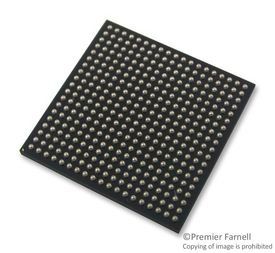
System-on-Chip Processor 361-Pin NFBGA
The TMS320DM6446 (also referenced as DM6446) leverages TI"s DaVinci technology to meet the networked media encode and decode application processing needs of next-generation embedded devices.The DM6446 enables OEMs and ODMs to quickly bring to market devices featuring robust operating systems support, rich user interfaces, high processing performance, and long battery life through the maximum flexibility of a fully integrated mixed processor solution.The dual-core architecture of the DM6446 provides benefits of both DSP and Reduced Instruction Set Computer (RISC) technologies, incorporating a high-performance TMS320C64x+ DSP core and an ARM926EJ-S core.The ARM926EJ-S is a 32-bit RISC processor core that performs 32-bit or 16-bit instructions and processes 32-bit, 16-bit, or 8-bit data. The core uses pipelining so that all parts of the processor and memory system can operate continuously.The ARM core incorporates: A coprocessor 15 (CP15) and protection module Data and program Memory Management Units (MMUs) with table look-aside buffers. Separate 16K-byte instruction and 8K-byte data caches. Both are four-way associative with virtual index virtual tag (VIVT). The TMS320C64x+ DSPs are the highest-performance fixed-point DSP generation in the TMS320C6000 DSP platform. It is based on an enhanced version of the second-generation high-performance, advanced very-long-instruction-word (VLIW) architecture developed by Texas Instruments (TI), making these DSP cores an excellent choice for digital media applications. The C64x is a code-compatible member of the C6000 DSP platform. The TMS320C64x+ DSP is an enhancement of the C64x+ DSP with added functionality and an expanded instruction set.Any reference to the C64x DSP or C64x CPU also applies, unless otherwise noted, to the C64x+ DSP and C64x+ CPU, respectively.With performance of up to 6480 million instructions per second (MIPS) at a clock rate of 810 MHz, the C64x+ core offers solutions to high-performance DSP programming challenges. The DSP core possesses the operational flexibility of high-speed controllers and the numerical capability of array processors. The C64x+ DSP core processor has 64 general-purpose registers of 32-bit word length and eight highly independent functional units--two multipliers for a 32-bit result and six arithmetic logic units (ALUs). The eight functional units include instructions to accelerate the performance in video and imaging applications. The DSP core can produce four 16-bit multiply-accumulates (MACs) per cycle for a total of 3240 million MACs per second (MMACS), or eight 8-bit MACs per cycle for a total of 6480 MMACS. For more details on the C64x+ DSP, see the TMS320C64x/C64x+ DSP CPU and Instruction Set Reference Guide (literature number SPRU732).The DM6446 also has application-specific hardware logic, on-chip memory, and additional on-chip peripherals similar to the other C6000 DSP platform devices. The DM6446 core uses a two-level cache-based architecture. The Level 1 program cache (L1P) is a 256K-bit direct mapped cache and the Level 1 data cache (L1D) is a 640K-bit 2-way set-associative cache. The Level 2 memory/cache (L2) consists of an 512K-bit memory space that is shared between program and data space. L2 memory can be configured as mapped memory, cache, or combinations of the two.
High-Performance Digital Media SoC Advanced Very-Long-Instruction-Word (VLIW) TMS320C64x+™ DSP Core C64x+ Instruction Set Features C64x+ L1/L2 Memory Architecture ARM926EJ-S Core ARM9 Memory Architecture Embedded Trace Buffer™ (ETB11™) With 4KB Memory for ARM9 Debug Endianness: Little Endian for ARM and DSP Video Imaging Co-Processor (VICP) Video Processing Subsystem External Memory Interfaces (EMIFs)
- 513-, 594-, 810-MHz C64x+™ Clock Rates
- 256.5-, 297-, 405-MHz ARM926EJ-S™ Clock Rates
- Eight 32-Bit C64x+ Instructions/Cycle
- 4104, 4752, 6480 C64x+ MIPS
- Fully Software-Compatible With C64x / ARM9™
- Extended Temperature Devices Available
- Eight Highly Independent Functional Units
- Six ALUs (32-/40-Bit), EachSupports Single 32-Bit, Dual 16-Bit, or Quad 8-Bit Arithmetic per ClockCycle
- Two Multipliers Support Four 16 x 16-Bit Multiplies (32-Bit Results) per Clock Cycle or Eight 8 x 8-Bit Multiplies (16-Bit Results) per Clock Cycle
- Load-Store Architecture With Non-Aligned Support
- 64 32-Bit General-Purpose Registers
- Instruction Packing Reduces Code Size
- All Instructions Conditional
- Additional C64x+™ Enhancements
- Protected Mode Operation
- Exceptions Support for Error Detection and Program Redirection
- Hardware Support for Modulo Loop Operation
- Byte-Addressable (8-/16-/32-/64-Bit Data)
- 8-Bit Overflow Protection
- Bit-Field Extract, Set, Clear
- Normalization, Saturation, Bit-Counting
- Compact 16-Bit Instructions
- Additional Instructions to Support Complex Multiplies
- 32K-Byte L1P Program RAM/Cache (Direct Mapped)
- 80K-Byte L1D Data RAM/Cache (2-Way Set-Associative)
- 64K-Byte L2 Unified Mapped RAM/Cache (Flexible RAM/Cache Allocation)
- Support for 32-Bit and 16-Bit (Thumb® Mode) Instruction Sets
- DSP Instruction Extensions and Single Cycle MAC
- ARM® Jazelle®: Technology
- EmbeddedICE-RT™ Logic for Real-Time Debug
- 16K-Byte Instruction Cache
- 8K-Byte Data Cache
- 16K-Byte RAM
- 8K-Byte ROM
- Front End Provides:
- CCD and CMOS Imager Interface
- BT.601/BT.656 Digital YCbCr 4:2:2 (8-/16-Bit) Interface
- Preview Engine for Real-Time Image Processing
- Glueless Interface to Common Video Decoders
- Histogram Module
- Auto-Exposure, Auto-White Balance and Auto-Focus Module
- Resize Engine Resize
- Images From 1/4x to 4x
- Separate Horizontal/Vertical Control
- Back End Provides:
- Hardware On-Screen Display (OSD)
- Four 54-MHz DACs for a Combination of
- Composite NTSC/PAL Video
- Luma/Chroma Separate Video (S-video)
- Component (YPbPr or RGB) Video (Progressive)
- Digital Output
- 8-/16-bit YUV or up to 24-Bit RGB
- HD Resolution
- Up to 2 Video Windows
- 32-Bit DDR2 SDRAM Memory Controller With 256M-Byte Address Space (1.8-V I/O)
- Up to 167-MHz Controller (A-513, -594)
- Up to 189-MHz Controller (-810)
- Asynchronous 16-Bit-Wide EMIF (EMIFA) With 128M-Byte Address Reach
- Flash Memory Interfaces
- NOR (8-/16-Bit-Wide Data)
- NAND (8-/16-Bit-Wide Data)
- Flash Memory Interfaces
Характеристики
| Бренд | Texas Instruments |
|---|---|
| Schedule B | 8542390000 |
| HTSN | 8542310001 |
| Страна происхождения | United States |
| Msl Level | 3 |
| Max Proce | 260 |
| Supplier | NFBGA |
| Описание продукта | 16 x 16 x 0.9 mm |
| Рабочая температура | 0 to 85 °C |
| Screening Level | Commercial |
SKU: TMS320DM6446ZWT